Target margin: check your selling price after rounding
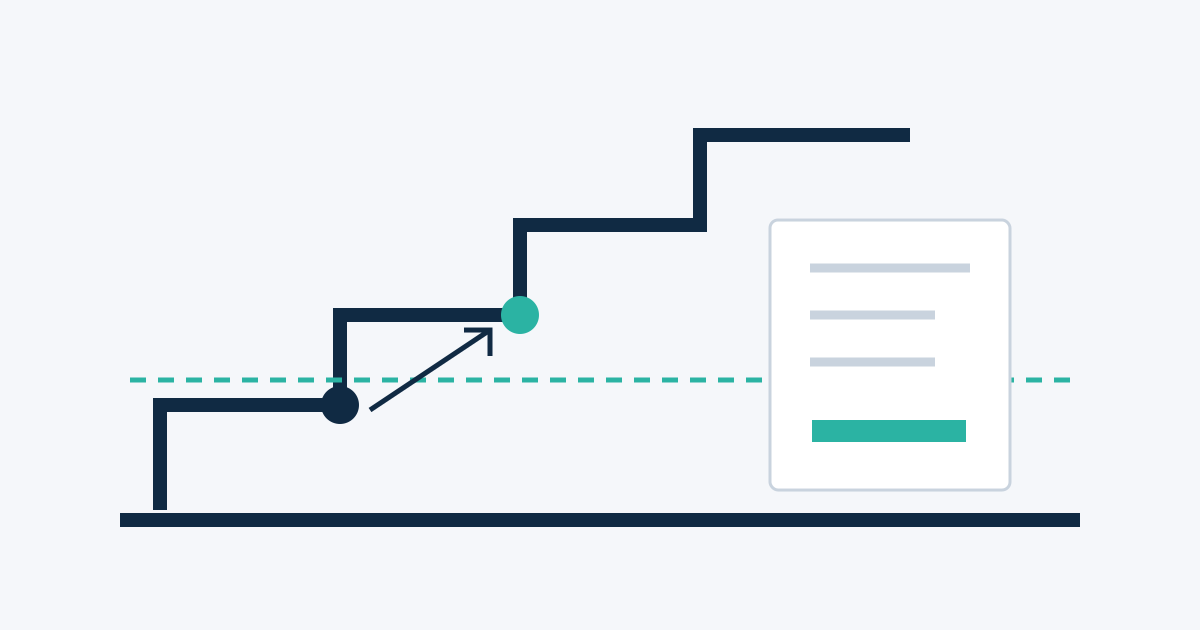
At cost 80, prices of 106.66 and 106.67 both display a 25.00% margin at two decimals, but only the higher price meets a 25% target. I solve the target first, then check the price the customer will actually pay.
Choose the target’s cost definition
A gross-margin target considers selling price and the unit cost you entered. A contribution-margin target also considers the percentage selling fee, fixed per-unit fee and shipping or packing. Those targets use different numerators, so they can require different prices. I label the included costs before comparing them. For example, cost 80 and gross target 20% require price 100. With fixed fee 2, shipping 3 and a 5% selling fee, a contribution target of 20% requires price 113.3333… instead. Neither target automatically includes the company’s rent, interest, tax or other costs that were not entered.
Solve the gross target without adding it to cost
Gross margin = (price − cost) ÷ price. If the desired decimal margin is m, then price − cost = price × m. Rearranging gives price = cost ÷ (1 − m). For cost 37.40 and target 32.5%, the denominator is 1 − 0.325 = 0.675; price = 37.40 ÷ 0.675 = 55.407407… . Adding 32.5% to cost would instead produce 37.40 × 1.325 = 49.555. That is a markup calculation, with gross margin only 0.325 ÷ 1.325 × 100 = 24.5283…%. The percentage base determines which equation belongs in the quote.
Move to the actual monetary increment
Suppose prices can use increments of 0.01 and the target is a minimum, rather than a value to approximate. Divide the exact price by 0.01, round that quotient upward, then multiply by 0.01. For 55.407407…, that gives 55.41. At cost 37.40, profit is 55.41 − 37.40 = 18.01; margin = 18.01 ÷ 55.41 × 100 = 32.5032…%. Rounding downward to 55.40 gives profit 18 and margin 18 ÷ 55.40 × 100 = 32.4910…%. These are arithmetic consequences, not a recommendation that buyers will accept a particular price.
Check what a two-decimal label conceals
A rounded percentage can make two different prices appear to satisfy the same exact target. Cost 80 at price 106.66 gives profit 26.66 and margin 24.995312…%, displayed as 25.00% at two decimals. At price 106.67, profit 26.67 produces margin 25.002344…%, also displayed as 25.00%. I do not use that rounded label as proof of equality. Switch to four displayed decimals for a closer view and compare the actual price with the unrounded target. The calculator does not automatically change a computed amount into a quoted retail price.
| Cost | Actual price | Gross margin | Compared with target |
|---|---|---|---|
| 80 | 106.66 | 24.995312…% | Below 25% |
| 80 | 106.67 | 25.002344…% | Above 25% |
| 37.40 | 55.40 | 32.490975…% | Below 32.5% |
| 37.40 | 55.41 | 32.503158…% | Above 32.5% |
Allow for fees inside the equation
Let K be unit cost plus fixed fee plus fulfilment, f the percentage fee as a decimal and t the target contribution margin. Contribution = price × (1 − f) − K. Requiring contribution to equal price × t gives price = K ÷ (1 − f − t). Cost 47.85, fixed fee 0.35 and shipping 4.20 sum to K = 52.40. With fee 6.75% and target 25%, the denominator is 1 − 0.0675 − 0.25 = 0.6825. The required transaction price is 52.40 ÷ 0.6825 = 76.776556… . Charging 76.78 yields contribution 76.78 × 0.9325 − 52.40 = 19.19735, or 25.0031…% of sales.
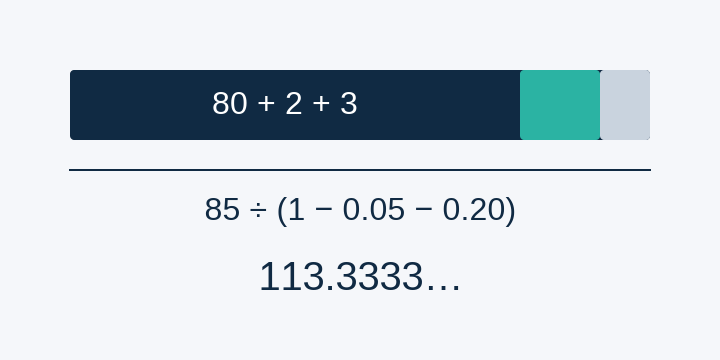
Turn a transaction target into a discounted list price
The target card gives the transaction price required after discounts. It is not an undiscounted list price. With planned discount d as a decimal, transaction price = list price × (1 − d), so list price = transaction target ÷ (1 − d). A target 113.3333… and discount 10% need list price 113.3333… ÷ 0.90 = 125.9259… . Quoting 125.93 gives discounted price 113.337. Keep any currency rounding imposed at checkout consistent with your comparison. A 100% discount cannot preserve a positive transaction target because the transaction price is zero.
Treat impossible targets as missing solutions
Positive costs with a 100% gross target cannot yield a finite selling price. In the contribution model, fee plus target must total less than 100%; otherwise no positive finite price covers positive costs and that target. When all included costs are zero, the target equation may not establish a unique positive price either. The calculator explains these limits rather than supplying an infinite amount. Mathematical feasibility also does not establish commercial feasibility. A very high price can satisfy an equation while being unsuitable for the product or market.
Keep the final quote with its assumptions
- Select cost plus margin for a gross target, or enter actual cost and price before applying the fee model.
- Keep included costs, currency and tax basis consistent.
- Solve the target using the entered commission and per-unit charges.
- Account for any planned discount when choosing a list price.
- Enter the actual transaction price and verify its margin before saving a comparison.
A saved comparison captures the discounted transaction price, quantity, cost, selling fees and fulfilment. CSV retains those costs so the contribution can be reproduced; the copy and print reports keep the entered discount and fee assumptions. Changing decimal places changes the screen, not stored calculations. I give each comparison a short descriptive name, such as “rounded quote”, so a target calculation is not confused with an actual offer. Device storage is optional; clearing inputs leaves saved comparisons in place until you clear their list.
For the percentage bases, read margin versus markup. For transaction costs, read discounts and selling fees. Return to the margin calculator to check the final amount. The gross-margin convention is described by BDC’s gross-profit margin definition.
Examples use hypothetical amounts in one currency. This is general information about pricing arithmetic, not financial or tax advice.
Common questions
Does display rounding change my calculation?
No. The selector changes only displayed values. Enter the actual quoted price to check the resulting margin.
Should I add my target margin to cost?
That calculates markup. A gross-margin target uses cost ÷ (1 − target/100).
Is the target price before my planned discount?
It is the required transaction price. The explanation below it calculates the list price for your entered discount and rounds that list price upward to the chosen decimal places. A full 100% discount cannot meet a positive-cost target.
Why can both prices show 25.00%?
At cost 80, prices 106.66 and 106.67 have margins 24.995312…% and 25.002344…%. Both round to 25.00% with two displayed decimals.