Margin vs markup: calculate the right selling price

Adding 20% to a cost of 80 gives a price of 96 and a margin of just 16.67%. To get a 20% margin, you need a price of 100. I check the denominator before calculating a quote: margin uses selling price, while markup uses cost.
Start with money, then divide
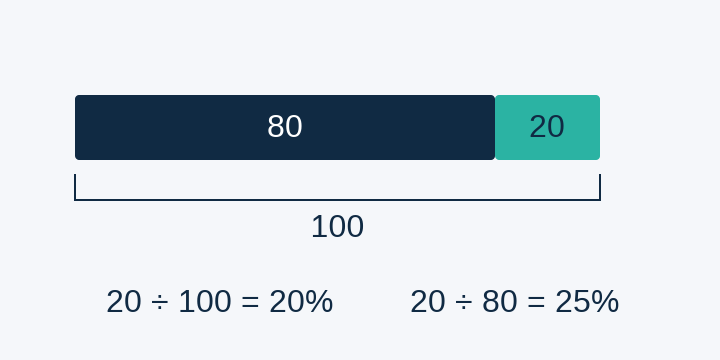
Subtract unit cost from selling price to obtain the profit amount. Cost 80 and price 100 give profit 20. Dividing 20 by price 100 gives margin 0.20, or 20%. Dividing 20 by cost 80 gives markup 0.25, or 25%. The profit has not changed between those calculations. Only the comparison base has changed. Keeping the amount visible helps catch a mistaken percentage label, especially when a pricing sheet has several columns with similar names.
Solve a gross-margin target directly
If m is the target margin as a decimal, profit must equal m times price. Since profit also equals price minus cost, price − cost = m × price. Rearranging gives price × (1 − m) = cost, then price = cost ÷ (1 − m). Cost 80 with target 25% therefore gives 80 ÷ 0.75 = 106.6667… . The gross profit is 26.6667… and that divided by 106.6667… is exactly one quarter before display rounding.
Markup multiplies the cost base
For markup u as a decimal, profit = cost × u, so selling price = cost × (1 + u). A 50% markup on 80 produces profit 40 and price 120. Its margin is 40 ÷ 120 = one third, not one half. To obtain a 50% margin instead, price must be 80 ÷ 0.50 = 160. Those are very different quotes. I would always ask which percentage basis a target refers to rather than assume that the label “profit percent” is precise enough.
Convert rates only when the bases exist
Margin = markup ÷ (1 + markup), using decimal rates. A 25% markup becomes 0.25 ÷ 1.25 = 0.20. In the other direction, markup = margin ÷ (1 − margin), so 20% becomes 0.20 ÷ 0.80 = 0.25. The conversion describes ratios, not price; a cost or price is still needed to calculate an amount. At markup − 100%, price is zero and margin has no denominator. At margin 100%, cost is zero and markup has no denominator. Do not force those endpoints into ordinary finite percentages.
A loss needs its original sign
If an item costs 120 and sells for 100, profit is − 20, margin is − 20% and markup is − 16.6667…%. Taking absolute values would disguise that the transaction loses money before further expenses. A chart should place that negative contribution on a signed axis and keep the displayed minus sign. A loss is not the same as an undefined ratio: a positive selling price still supports a negative margin. Undefined means the denominator is zero, not that the result is inconvenient.
Use consistent cost definitions
A quote calculation is only as meaningful as the included costs. BDC defines gross margin from net sales and direct cost of goods sold. If one comparison includes packing and another excludes it, the percentages are not comparable without that difference being stated. The separate selling-fee section in this calculator is a contribution model. It does not automatically include rent, financing, income tax, returns or advertising. Keep a short note about the included costs when saving a comparison rather than treating the percentage as a full measure of company profitability.
Round the quote after solving
The calculator keeps internal precision and lets you choose zero through four displayed decimals. A target price 106.6667… displayed as 106.67 is slightly above the exact 25% target, while 106.66 is slightly below it. If you quote a rounded retail amount or a whole currency unit, enter that actual amount with cost and recalculate. A displayed two-decimal percentage can conceal a small difference, so do not infer exact equality from the rounded label. The money actually charged determines the actual ratio.
Do not average different sales percentages
Suppose one unit sells for 100 with profit 20 and another sells for 10 with profit 5. Their margins are 20% and 50%. Total sales 110 and profit 25 give a combined 22.7273…% margin. A simple mean of 35% gives the small sale equal influence to the large sale, which is incorrect for an aggregate margin. Quantities also matter: multiply each row’s sales and profit by the number of units before dividing totals. Keep different currencies in separate groups unless amounts have already been consistently converted outside this tool.
Keep the selected pair explicit
Select cost plus price to evaluate an actual quote, cost plus margin to solve a target, or price plus margin to find the implied cost. The calculator also supports the equivalent markup pairs. Inputs stay distinct from computed outputs, which avoids accidentally reusing a rounded output as a new independent assumption. Copy the cost, price, profit and both percentages together. Saved comparisons reflect the selected discount and quantity, and can be remembered on the device only after you enable that option. A saved file remains separate from the page’s current inputs.
| Inputs | Working | Result |
|---|---|---|
| Cost 80, price 100 | Profit 20 | Margin 20%; markup 25% |
| Cost 80, target margin 20% | 80 ÷ 0.8 = 100 | Selling price 100 |
| Cost 80, markup 50% | 80 × 1.5 = 120 | Margin 33.33% |
| Cost 120, price 100 | Profit − 20 | Margin − 20%; markup − 16.67% |
| Cost 0, price 100 | Profit 100 | Margin 100%; markup undefined |
- Select the two independent values that are actually known.
- Keep unit costs, transaction price and currency consistent.
- Evaluate the discount and entered fees separately.
- Retain undefined ratios and loss signs instead of hiding them.
- Recalculate with the actual rounded price you plan to compare.
Calculate margin and selling costs. Definitions: BDC gross margin and BDC net margin.
To price a discounted sale, check selling fees and contribution. Before quoting the final amount, compare target margins after price rounding.
Examples use hypothetical amounts in one currency. This is general information about pricing arithmetic, not financial or tax advice.
Common questions
Is a 25% markup the same as a 25% margin?
No. On cost 80, 25% markup gives price 100 and margin 20%. A 25% margin needs price 106.6667… .
Can margin be negative?
Yes. Costs above sales give a loss and a negative margin when sales are positive.
Why is a percentage undefined?
The denominator is zero. Zero sales makes margin undefined; zero cost makes markup undefined.
How do I combine product margins?
Divide the sum of quantity-weighted profits by the sum of sales. Sales 100 and 10 with profits 20 and 5 give 25 ÷ 110 × 100 = 22.73%, not the simple average of 35%.