Discounts, selling fees and contribution per unit

A 10% discount can halve your gross profit: at price 100 and cost 80, profit falls from 20 to 10. The new margin is 11.11%. I check the money left after the discount, then subtract the selling fees and shipping.
Apply the discount to sales only
Discounted price = original price × (1 − discount/100). Unit cost stays fixed in this simple model. Price 100 with discounts 0%,10%,20% and 30% produces prices 100, 90, 80 and 70. With cost 80, gross profits are 20, 10, 0 and − 10. The corresponding margins are 20%,11.1111…%,0% and − 14.2857…%. A 100% discount gives zero sales, where margin is undefined. This model assumes one unit is still supplied at the entered cost; it does not model returned inventory or reduced production costs.
Charge proportional fees on the actual price
If the fee rate is 5%, an actual transaction price 90 creates a fee of 90 × 0.05 = 4.50. A fixed fee of 2 makes total selling fees 6.50. Add shipping or packing 3 and product cost 80: contribution = 90 − 80 − 6.50 − 3 = 0.50. Contribution margin = 0.50 ÷ 90 × 100 = 0.5556…%, shown as 0.56%. Applying the percentage fee to the undiscounted 100 would be a different assumption. This tool uses the discounted selling price and states the formula next to its results.
Keep gross profit and contribution separate
Gross profit here is selling price minus the entered unit cost. Contribution then subtracts the entered proportional fee, fixed per-unit fee and fulfilment. The distinction prevents a fee entry from silently changing the meaning of the gross-margin card. It also avoids calling the contribution result “net profit.” BDC’s net-margin definition involves net income after additional business expenses, interest and taxes. A product calculation cannot claim that company-wide result merely because it includes a shipping label and a transaction commission.
Find the transaction break-even price
Let total fixed-per-unit costs be K = unit cost + fixed fee + fulfilment, and percentage fee rate be f as a decimal. Contribution = price × (1 − f) − K. Set contribution to zero, giving price = K ÷ (1 − f). With cost 80, fixed fee 2 and shipping 3, K = 85. With fee 5%, break-even price = 85 ÷ 0.95 = 89.4737… . It is a break-even price for this entered transaction model, not the sales volume needed to cover an entire company’s fixed overhead.
Solve a target after the percentage fee
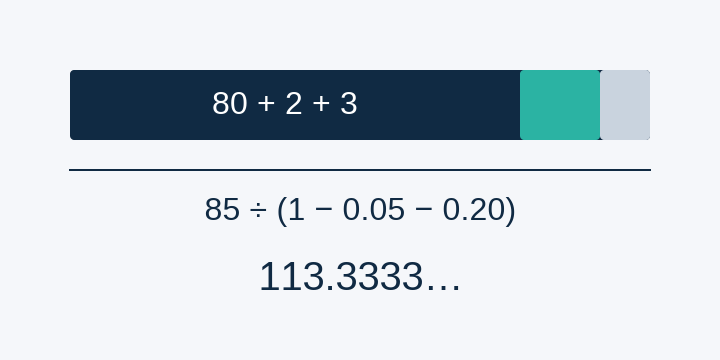
For target contribution margin t, contribution must equal price × t. Therefore price × (1 − f − t) = K and price = K ÷ (1 − f − t). K 85, fee 5% and target 20% give 85 ÷ 0.75 = 113.3333… . At that exact price the proportional fee is 5.6667… and contribution is 22.6667…; dividing contribution by price gives 20%. The target card solves the actual transaction price. The calculator also shows the list price needed for your entered discount. At a 10% discount, divide the exact transaction target by 0.90: 113.3333… ÷ 0.90 = 125.9259… . A 100% discount cannot cover positive costs. Check the final rounded price before quoting it.
A target can be impossible under the model
When fee and target margin sum to 100% or more, the denominator is zero or negative. With positive entered costs there is no positive finite selling price meeting that equation. The tool displays an undefined target and explains the condition. If all entered costs are zero, a target-price calculation also lacks a useful positive scale: increasing price does not establish a unique amount. Actual price inputs can still be evaluated, with a zero-cost markup shown as undefined. These are mathematical boundaries rather than recommendations about a feasible market price.
Quantities multiply amounts, not percentages
Selling two units at price 90 gives sales 180. Product cost 160, selling fees 13 and shipping 6 leave contribution 1, so the contribution margin remains 1 ÷ 180 × 100 = 0.5556…%. This assumes the fixed fee is per unit. A per-order fee spread across a multi-unit order must first be allocated consistently into the per-unit field. Shipping that is flat per parcel likewise needs an appropriate per-unit allocation. The calculator does not guess order size, combine shipping automatically or retrieve a marketplace’s current fee schedule.
Compare scenarios using the same assumptions
The scenario table repeats the same product cost, fee rate, fixed fee and fulfilment across several discounts. That isolates the effect of changing transaction price. A row with a different marketplace fee or shipping method belongs in a separately saved comparison. Saved rows retain the transaction price and quantity at the moment you save them. Their weighted totals divide total gross profit or contribution by total sales. Currency groups remain separate, and changing the display selector never converts previously entered amounts into another currency.
Keep exported assumptions with the numbers
Copying the report includes the chosen discount, fee rate, fixed fee, shipping, target and quantity alongside the gross and contribution results. CSV uses ungrouped numeric values and protects text names that begin like spreadsheet formulas. Remembered comparisons require an explicit checkbox; otherwise they remain in the current tab. Downloaded or printed copies are separate records and can be visible wherever you save them. Before comparing a future quote, check the actual fee terms and the costs included rather than assuming an old saved scenario still reflects the transaction.
| Discount on 100 | Transaction price | Gross profit | Contribution | Contribution margin |
|---|---|---|---|---|
| 0% | 100 | 20 | 10 | 10% |
| 10% | 90 | 10 | 0.50 | 0.56% |
| 20% | 80 | 0 | − 9 | − 11.25% |
| 30% | 70 | − 10 | − 18.50 | − 26.43% |
Every row holds unit cost at 80, percentage fee at 5%, fixed fee at 2 and shipping at 3. For example, price 70 incurs selling fees 70 × 0.05 + 2 = 5.50, leaving contribution 70 − 80 − 5.50 − 3 = − 18.50. This table illustrates why gross break-even and contribution break-even differ.
- Enter the product cost and the price before the discount.
- Apply the discount to find the actual transaction price.
- Enter the commission rate charged on that price.
- Allocate fixed fees and shipping per unit, then check contribution.
- Save each alternative with the same cost definition and currency.
Calculate margin and selling costs. Definitions: BDC gross margin and BDC net margin.
For the difference between the two percentage bases, read margin versus markup. For the final quoted amount, check target margins and price rounding.
Examples use hypothetical amounts in one currency. This is general information about pricing arithmetic, not financial or tax advice.
Common questions
Does a 10% discount remove 10% of my profit?
No. At price 100 and cost 80 it removes 10 from profit 20, halving gross profit. Fees can reduce the remaining contribution further.
What price breaks even after fees?
With unit cost 80, fixed fee 2, shipping 3 and a 5% fee, the transaction break-even price is 85 ÷ 0.95 = 89.4737… .
Is the target card a list price before a discount?
No. It is the required transaction price. With a planned 10% discount, divide that target by 0.90 to find the corresponding list price.
Can I enter a fee charged once per order?
Allocate it per unit before entering it. A fixed fee of 2 for four units would be 0.50 per unit under that allocation.